Last Updated: November 11, 2026
Quick Summary
Match the beach to your kids' ages first: calm-water bays with shallow entry suit babies and toddlers, while mild-surf beaches with room to run suit older kids. On remote beaches without lifeguards, an adult must watch the water, not the sand, and stay within arm's reach of children under about 8.
- Check the water for ten minutes before unpacking, since a quiet-looking shore may not be calm.
- Download a tide app before you lose signal, because high tide shrinks the dry sand fast.
- A four-wheel drive rental is the practical choice for shores past the paved stretch.
- Pack one liter of water per person minimum, plus a pop-up shade tent or large umbrella.
- Save the emergency number 911 to your phone and write it on paper too.
Table of Contents
- Start With the Right Remote Beach for Your Kids' Ages
- Costa Rica Beach Safety for Children: Currents, Tides, and Surf
- Driving to Remote Beaches in Costa Rica: Roads, 4WD, and Drive Times
- What to Pack for a Beach Day With Kids on a Secluded Shore
- Food, Water, Shade, and Bathroom Breaks With No Facilities
- Phone Coverage, Emergency Contacts, and the Nearest Medical Care
- Book a Base Near the Beaches You Want to Reach
- Frequently Asked Questions
Start With the Right Remote Beach for Your Kids' Ages
The best remote beach for young kids is a calm-water bay with a short walk from parking; for older kids, a moderate-surf beach with room to run is often better. Matching the beach to your children's ages is the single most useful step in planning tips for traveling to remote Costa Rica beaches with kids. Families often book the wrong shore for their children's ages, then spend the day managing fear instead of enjoying the water.
Age changes everything about what "good beach" means:
- Babies and toddlers: flat, shallow entry, no shore break, soft sand, shade within steps.
- Ages 5-8: calm coves where they can wade waist-deep with an adult beside them.
- Ages 9-12: mild surf they can bodyboard, plus rocks and tide pools to explore.
Calm-Water Beaches vs. Surf Beaches: What Each Age Can Handle
Calm-water beaches suit babies and toddlers because the water stays shallow and waves stay small. Surf beaches suit older kids and teens who want to bodyboard, but demand constant adult eyes. Don't assume a quiet-looking shore is calm, check the water for ten minutes before unpacking.
Match the shore to your children's ages before you book anything.
| Age group | Best beach profile | Key detail |
|---|---|---|
| Babies and toddlers | Calm-water bay | Flat, shallow entry, no shore break, shade within steps |
| Ages 5-8 | Calm coves | Wade waist-deep with an adult beside them |
| Ages 9-12 | Mild surf beach | Bodyboarding plus rocks and tide pools to explore |
| Teens | Surf beach | Bigger waves, snorkeling, space to roam with a meeting point |
Costa Rica Beach Safety for Children: Currents, Tides, and Surf
Costa Rica beach safety for children starts with one rule: an adult watches the water, not the sand. Rip currents are the main hazard on Pacific shores, pulling swimmers away faster than most parents expect. Many remote beaches have no lifeguard towers, so your own read of the water is an essential safety step. Hazard level also changes beach by beach and hour by hour, a shore calm at 8 a.m. can be dangerous by 2 p.m. as the tide turns and afternoon wind builds.
How Tides Change the Beach You Arrived At
Tides change the waterline considerably on the Pacific coast between low and high tide. That matters for kids in three concrete ways:
- High tide shrinks the dry sand. A beach wide at low tide can leave a toddler with almost no dry play area within hours. Check a tide table and note when high tide lands.
- Low tide exposes the steepest entry. On many Pacific shores the sand drops off more sharply at low tide, so the shallow wading zone is narrowest then.
- Tide plus swell equals the real hazard. A moderate swell at high tide is a different beach than at low tide. If the tide table and swell forecast line up badly, pick a calmer shore or a pool day.
Tide tables are available for the main coastal reference points through tide apps; download one before you lose signal.
Reading the Water Before Anyone Gets In
Stand at the sand for five full minutes and look for these signs:
- A channel of darker, choppier water running out between waves: that is a rip current.
- Waves breaking close together with a loud crash: strong shore break, risky for small kids.
- A steep drop-off a few steps in: keep toddlers at the edge.
Teach kids the escape move before they enter: swim parallel to shore, then angle back in. Never fight the current straight on. For children under about 8, an adult must be within arm's reach in the water at all times, not watching from a towel.
Beach-by-Beach Hazard Profiles for Families
Hazard level is not uniform across the coast, and the differences matter when you are choosing where to take children:
- Calm bay and gulf shores: the most forgiving profile for babies and toddlers, shallow, gradual entry, small shore break, waist-deep water for a distance. Prioritize these with the youngest kids.
- Open Pacific surf beaches: strong shore break, rip channels, bigger swell. Suitable for older kids and teens with constant supervision, not wading toddlers.
- River-mouth and estuary-adjacent beaches: often calmer but murkier, with stronger currents at the outflow and more wildlife. Good for exploring, poor for swimming after rain.
A common pattern is that families book a base near one beach and assume every nearby shore behaves the same. They do not. Ask your host which specific shore is calmest for small children and which one locals avoid with kids.
Lifeguards, Flags, and the Reality of Remote Shores
Many remote beaches have no lifeguard service and no flag system. Where guards are present, swim between the flags and follow their signals. Where they are absent, your safety system is your own preparation: a designated water-watcher adult, a meeting point, and a hard rule that no child enters the water without an adult already in it.
Watch out: a beach that is empty of other swimmers is not proof it is safe. It often means locals know something about the current, the drop-off, or the day's conditions that you do not.
Driving to Remote Beaches in Costa Rica: Roads, 4WD, and Drive Times
Driving to remote beaches in Costa Rica usually means gravel roads, river crossings, and steep final approaches. A four-wheel drive rental is often the practical choice for shores past the paved stretch, and map drive times can differ from reality on remote routes.
The Three Road Types You Will Meet
Remote-beach access breaks down into three road types, and each demands a different decision:
- Paved highway: fast and predictable. Cover distance here and build your time buffer on this leg, not the gravel.
- Lastre (gravel or dirt) road: the standard approach to most remote shores. Speed drops sharply, washboard surfaces shake the car, and dust or mud depends on season. Expect to drive considerably slower than on pavement.
- Final track or river crossing: the last kilometer or two to the sand. Often steep, rutted, and sometimes crossed by a shallow river. This is where a sedan fails and a 4WD earns its price.
Realistic Drive-Time Planning With Kids
Build your day around these planning rules rather than a GPS estimate:
- Allow extra time beyond the mapped time for any route with a gravel leg, especially in the rainy season.
- Plan to arrive before mid-morning. Light is good, sand is cool, and you leave margin to return before afternoon rain.
- Set a hard turnaround time. Remote roads are worse in the dark, and a tired child plus a rough road at dusk is the day you do not want.
4WD, Clearance, and Rental-Car Trade-offs
A four-wheel drive rental is the practical choice for remote shores, but the trade-off is real: 4WD costs more per day, burns more fuel, and is less comfortable on highway legs. For a family based near paved access visiting one or two remote beaches, a high-clearance SUV without full 4WD is often enough. For a shore reached by a river crossing or steep final track, full 4WD is not optional.
Before you leave town:
- Check the spare tire, jack, and tools. A flat on a gravel road with no spare is a multi-hour problem.
- Confirm the rental agreement covers gravel roads. Some policies exclude them; know before you drive.
- Download offline maps. Signal drops on the last stretch, and a wrong turn on a track is costly.
River Crossings and Rainy-Season Reality
A shallow river crossing is common on the approach to some remote shores. Cross slowly in first gear, keep momentum steady, and never enter fast-moving or visibly rising water, turn around instead.
Watch out: rental sedans are frequently driven onto gravel roads they cannot handle, and the damage waiver rarely covers the underside. Match the vehicle to the final road, not to the highway leg.
What to Pack for a Beach Day With Kids on a Secluded Shore
What to pack for a beach day with kids on a secluded shore comes down to self-sufficiency: no facilities means no shop, no tap, and no shade unless you bring it. Build your kit around sun, water, and a fast exit.
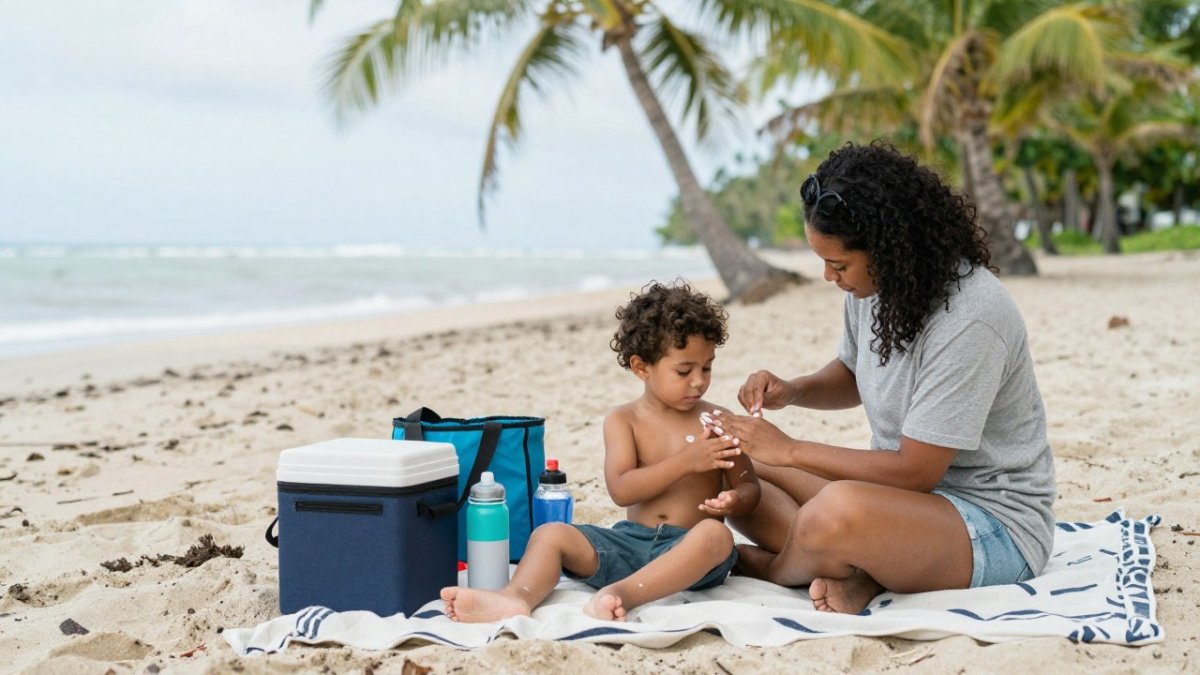
Our packing checklist for a remote beach day:
- Reef-safe sunscreen, SPF 50, reapplied every two hours
- Wide-brim hats and UV swim shirts for every child
- Insect repellent for the late afternoon
For a wider look at low-impact travel, see our guide on how to plan a sustainable Costa Rica trip.
Food, Water, Shade, and Bathroom Breaks With No Facilities
Remote beaches have no bathrooms, taps, or food stalls, so plan every basic need before you park. Bring your own shade, carry out everything you bring in, and treat bathroom breaks as logistics solved in advance. A portable changing mat and a stash of bags handle the youngest kids; older children do fine with an agreed spot behind the tree line and a roll of tissue.
Food and water need the most thought:
- Pack a real lunch, not just snacks. Hungry kids melt down fast.
- Freeze water bottles the night before; they double as cooler packs.
- Skip heavy meals right before swimming.
For local food stops that break up the day, our guide to authentic cultural experiences lists family-friendly options worth the detour.
Phone Coverage, Emergency Contacts, and the Nearest Medical Care
Phone coverage can fade on the last stretch to remote beaches, so plan for limited signal at the sand. Save the emergency number 911 to your phone before you leave, and write it on paper too.
Set up before you go:
- Share your location with someone staying elsewhere.
- Save the local Red Cross number and your rental car's roadside line.
- Know the nearest clinic to your beach and the route to it.
A scrape or a sting is manageable with your kit. A head injury or a deep cut is not a remote-beach problem; drive out and get care.
Book a Base Near the Beaches You Want to Reach
Booking a base near the beaches you want to reach cuts drive time and keeps tired kids off long roads at day's end. If you are weighing which stretch of coast suits your family, our list of the best hidden beaches for families is a good place to start.
For owners, this is where Marquis Stays Property Management comes in. If you own a luxury villa and want it working harder, see our luxury vacation rental management in Potrero.
Remote beaches reward families who plan the boring parts: the road, the water, the water bottles. Marquis Stays Property Management keeps the property side of that equation handled, with full-service management for remote owners, data-driven revenue optimization, and five-star guest care that keeps bookings coming back.
Frequently Asked Questions
What should families pack for a remote beach day with kids?
Bring more water than you think you need, since there are no shops once you leave the main road. Pack a soft-sided cooler with food that holds up in heat, a shade tent or large umbrella, sun protection, insect repellent, a basic first-aid kit, and a fully charged power bank. Add rash guards, a change of clothes per child, and a dry bag for phones. A printed list of emergency contacts matters too, because phone coverage on remote beaches is unreliable.
Do you need a 4x4 to reach remote beaches?
For many secluded beaches, yes. Paved roads often give way to gravel, rutted dirt tracks, and stretches that flood during the rainy season. A high-clearance four-wheel-drive rental handles these conditions far better than a sedan, and some access roads are genuinely impassable without it. Ask your rental company directly whether the specific road you plan to take is suitable, confirm your insurance covers dirt roads, and check current conditions with a local before setting out.
How can you tell whether a remote beach is safe for children to swim?
Look for calm water with small, gentle waves and no visible rip current, which appears as a channel of darker, choppier water running out from shore. Check tide tables before you go, since some beaches lose their dry sand at high tide. Remote beaches usually have no lifeguards, so keep children within arm's reach in the water and set firm rules about how far they can wade. If the surf looks strong or the water is murky, keep the day to sand play.
How should families prepare for limited phone service at remote beaches?
Download offline maps before leaving your accommodation and tell someone reliable where you are going and when you expect to be back. Save emergency numbers in advance, including the emergency line at 911. Carry a power bank and keep phones in a dry bag. If anyone in the group has a medical condition, note the nearest clinic or hospital on your route before you drive out.