Table of Contents
- Start with a Carbon Budget for Your Itinerary
- Choosing Eco-Friendly Luxury Vacation Rentals Guanacaste
- Understanding the Certification for Sustainable Tourism Costa Rica
- Getting Around: Public Transport vs. Private Shuttle Logistics
- Supporting Local Communities in Tamarindo and Potrero
- Day-to-Day Sustainable Practices: Water, Waste, and Wildlife
- Sustainable Packing List and Off-Season Planning
- Conclusion: Your Sustainable Costa Rica Trip Starts Now
- Frequently Asked Questions
Last Updated: September 7, 2026
Planning a truly sustainable Costa Rica trip requires more than booking an eco-lodge. It demands a deliberate strategy considering your carbon footprint, accommodation choices, and the communities you visit. This guide from Marquis Stays Property Management, which manages luxury vacation homes across Guanacaste, Potrero, and Tamarindo, breaks down how to plan a sustainable Costa Rica trip without sacrificing comfort, starting with a concept most travelers overlook: a carbon budget.
Start with a Carbon Budget for Your Itinerary
A carbon budget is the most effective way to plan a sustainable Costa Rica trip because it forces you to quantify your environmental impact before booking. The flight dominates your footprint, so the first decision is whether you fly direct and stay longer or take a cheaper route with layovers. Direct flights are almost always the more sustainable choice for long-haul travel.
Once you arrive, every kilometer by rental car, shuttle, or domestic flight adds to your total. Map your itinerary and estimate distances, then choose the lowest-emission option for each leg. For example, Liberia Airport to Tamarindo is a short drive, but flying from San José to La Fortuna and back can double your ground emissions. Consolidating your trip into one or two regions is the single biggest lever you can pull.
Choosing Eco-Friendly Luxury Vacation Rentals Guanacaste
For travelers who want sustainability without sacrificing comfort, eco-friendly luxury vacation rentals Guanacaste offer the best of both worlds. The key is verifying that a property's environmental claims are real. Look for homes with solar water heating, greywater recycling systems, native landscaping requiring minimal irrigation, and energy-efficient air conditioning and LED lighting.
What to Look for in a Rental Property
When evaluating a rental, ask the property manager three questions: Does the home source water from a private well or local aqueduct with a filtration system that reduces bottled water use? Are cleaning products eco-friendly and reef-safe, particularly near the coast? Does the management company support local staff with fair wages and benefits? Properties managed by local teams tend to have stronger community ties and better environmental practices.
Understanding the Certification for Sustainable Tourism Costa Rica
The Certification for Sustainable Tourism Costa Rica (CST) is a national program rating hotels and rentals on environmental, social, and economic impact. Using a leaf rating system, one leaf indicates basic compliance and five leaves represent world-class sustainability. A CST rating gives you a verifiable standard rather than vague claims.
That said, the CST program primarily covers hotels and lodges, and many private vacation rentals in Guanacaste are not formally certified even when they follow sustainable practices. If you are booking a rental, ask the manager whether they follow CST-style guidelines, such as waste separation, water conservation, and local hiring. The official Certification for Sustainable Tourism program provides a searchable database of certified properties, which is a useful starting point for your research. A property that openly discusses its sustainability practices, even without formal certification, is often a better choice than one that stays silent.
Getting Around: Public Transport vs. Private Shuttle Logistics
Costa Rica's public bus system is extensive, cheap, and navigable if you understand its structure. The key distinction is between long-distance direct buses ("directos") and local buses that stop everywhere. The route from San José to La Fortuna has multiple direct buses daily, taking roughly 3.5 to 4 hours and costing around 3,000 to 4,500 CRC ($6 to $9 USD), versus $50 to $70 per person by private shuttle. That price difference is the real trade-off: money versus time and convenience.
For Liberia Airport to Tamarindo, the public bus requires a transfer at the Liberia terminal, adding about an hour to a 1.5-hour direct shuttle trip. With surfboards or large luggage, the bus becomes impractical. A shared shuttle costs roughly $25 to $35 per person and runs on a schedule tied to flight arrivals. The carbon math is clear: a shared shuttle carrying 8 passengers emits far less per person than a rental car, and even less than a bus only 20% full.
Route-Specific Advice for Guanacaste
In Guanacaste beach towns, the bus network is thinner than the Central Valley but functional. The direct bus from San José to Tamarindo runs twice daily and takes about 5 hours. From Tamarindo, local buses connect to Potrero, Brasilito, and Flamingo several times daily for under $2 per ride. The catch is frequency: buses run every 1 to 2 hours, and the last often leaves before 6 PM, leaving a $20 to $30 taxi ride between towns.
A practical pattern is to combine modes: take a shared shuttle from the airport to your first base, use local buses for day trips, and book a private shuttle only for the return. This hybrid approach cuts emissions by an estimated 30-40% compared to renting a car for the entire stay.
The Rental Car Reality Check
If you rent a car, the vehicle choice matters. A typical SUV burns 8-10 liters per 100 km on hilly terrain; a hybrid like the Toyota RAV4 Hybrid uses roughly 5-6 liters. Over a 500 km trip across the Nicoya Peninsula, that difference adds up to about 20 liters of fuel, or roughly 50 kg of CO2. Most agencies in Liberia and San José offer hybrids, but they book out quickly during peak season, so reserve early and request one.
A common mistake is assuming domestic flights are faster and greener than ground transport. The flight from San José to Tamarindo takes 45 minutes, but with security, boarding, and the drive from the airstrip, total time is comparable to a 4-hour shared shuttle. The flight emits roughly 60-80 kg of CO2 per passenger; the shuttle emits about 15-20 kg. For short hops within Guanacaste, ground transport is almost always more sustainable.
Supporting Local Communities in Tamarindo and Potrero
Sustainable travel extends to supporting local communities in Tamarindo and Potrero, where tourism is the economic lifeblood. Eating at sodas, the small family-run restaurants serving traditional casados, keeps money in the local economy far more effectively than dining at international chains. The same applies to tours: choosing local guides ensures your money supports residents rather than foreign corporations.
Guanacaste has a strong tradition of community-based tourism, and many local families offer experiences like cooking classes, horseback riding, and farm visits that provide authentic cultural exchange. When you book these experiences, you are directly funding sustainable development in the region. The Costa Rica's community-based tourism network connects travelers with vetted local operators across the country. Shopping at local markets for coffee, chocolate, and handmade crafts also supports small-scale producers and reduces the carbon footprint of imported goods.
Day-to-Day Sustainable Practices: Water, Waste, and Wildlife
Daily habits determine the true sustainability of your Costa Rica trip. Water is the most pressing concern in Guanacaste, which has a pronounced dry season from December to April. Take shorter showers, reuse towels, and never leave the tap running while brushing your teeth. Many luxury rentals install low-flow fixtures, but your behavior still matters.
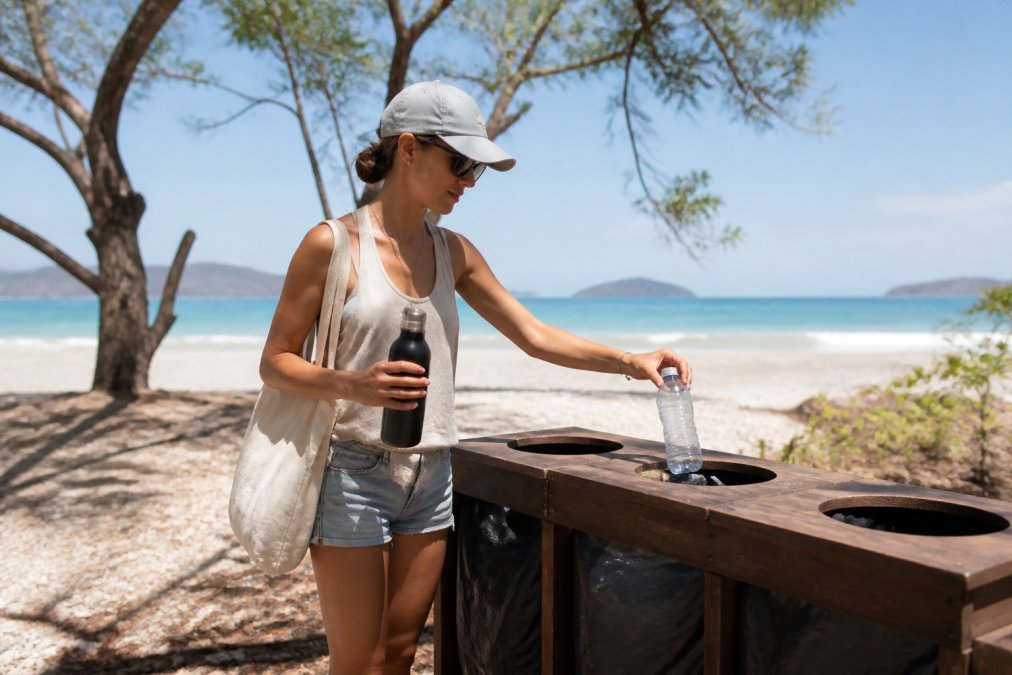
Waste management is equally critical. Costa Rica has made significant progress on recycling, but the infrastructure varies by town, so ask your property manager how to separate waste correctly. Bring a reusable water bottle with a filter, since tap water is potable in most of the country, and refuse single-use plastics whenever possible. When it comes to wildlife, the rule is simple: observe from a distance and never feed or touch animals. Choosing certified reef-safe sunscreen options protects the coral reefs along the Pacific coast, and avoiding attractions that keep wild animals in captivity supports ethical wildlife tourism.
Sustainable Packing List and Off-Season Planning
Packing strategically reduces waste before you arrive, but standard advice about reusable bottles and reef-safe sunscreen only scratches the surface. A truly sustainable packing list requires thinking about what happens to every item after you use it. Here is a detailed checklist organized by category.
The Core Sustainable Packing Checklist
Water and Beverages
- Reusable water bottle with a built-in filter (e.g., Grayl Geopress or LifeStraw Go). Tap water is potable in most of the country, but a filter adds peace of mind in rural areas and eliminates the temptation to buy plastic bottles.
- Collapsible silicone cup for coffee at sodas or market stalls that may not have reusable cups.
- Reusable coffee filter if you plan to brew your own coffee, many rentals provide drip machines but not filters.
Sun Protection
- Reef-safe sunscreen (look for zinc oxide or titanium dioxide as the active ingredients; avoid oxybenzone and octinoxate, which are banned in Costa Rica's marine protected areas). Brands like Raw Elements and Thinksport are widely available and actually work in tropical conditions.
- UPF-rated clothing (long-sleeve rash guards and sun hats) reduces the amount of sunscreen you need to apply and reapply.
Waste Reduction
- Reusable produce bags for market shopping. Costa Rica has banned single-use plastic bags in many commercial establishments, and having your own bag makes shopping at local markets far easier.
- Bamboo or metal straw, though increasingly unnecessary as more restaurants adopt paper straws, having one avoids the awkward moment when a vendor offers plastic.
- A small dry bag for beach days. It replaces the plastic bags you would otherwise use to protect your phone and wallet from sand and water.
Clothing and Laundry
- Quick-dry clothing made from natural fibers (merino wool, cotton, linen) or recycled synthetics. Avoid virgin polyester and nylon, which shed microplastics into waterways with every wash.
- A travel clothesline and eco-friendly laundry soap sheets. Many rentals charge for laundry service, and using the sink with a clothesline reduces energy and water consumption compared to a washing machine.
Electronics
- Rechargeable battery pack (10,000 mAh minimum) so you are not buying disposable AA batteries for cameras or flashlights.
- A solar-powered charger if you plan to spend extended time in remote areas without reliable electricity.
Off-Season Travel: The Overlooked Sustainability Lever
The green season, from May to November, is the single most impactful sustainability decision after choosing your flight. Accommodations operate at lower occupancy, meaning less water and energy per guest; popular parks like Manuel Antonio and Arenal Volcano see 40-60% fewer visitors, reducing trail erosion and wildlife disturbance; and rain replenishes the aquifers Guanacaste depends on during dry months.
What the Green Season Actually Looks Like
The common fear is that green season means constant rain. In Guanacaste, it typically features clear, sunny mornings with rain arriving between 2 PM and 5 PM, intense but short-lived, lasting 30 minutes to 2 hours. This pattern favors outdoor activities: morning hikes, beach time, and waterfall visits are viable, while afternoon plans should be flexible. Some tours, like the Rio Celeste hike in Tenorio Volcano National Park, are more spectacular during green season because water flow is stronger and the blue color more vivid.
The Economic Case for Shoulder Season
If the full green season feels too risky, the shoulder months of May and November offer a middle ground. In May, rain is just beginning and the landscape transitions from dry brown to lush green. In November, rain tapers off and beaches are uncrowded. Both months offer rates 20-40% lower than the December-April peak, and local businesses are eager for customers. This spreads tourism revenue more evenly, helping communities avoid the boom-and-bust cycle of dry months.
The Off-Season Trade-Offs
Off-season travel has challenges. Some smaller sodas and tour operators close during the slowest weeks of September and October, so verify availability before booking. Rain also means higher humidity, which can make non-air-conditioned accommodations uncomfortable. If staying in a luxury rental with reliable AC, this is less of an issue. Plan your itinerary with indoor backup options, cooking classes, coffee tours, and spa days, for rainy afternoons.
Conclusion: Your Sustainable Costa Rica Trip Starts Now
Planning a sustainable Costa Rica trip is not about perfection; it is about informed choices that compound across your journey. A carbon budget, a verified eco-friendly rental, and a commitment to local communities reduce your impact far more than any single gesture. The infrastructure for sustainable travel in Guanacaste grows stronger every year, and travelers who ask the right questions drive that progress.
If you are considering eco-friendly luxury vacation rentals Guanacaste for your stay, Marquis Stays Property Management provides full-service luxury vacation rental management for high-end coastal homes in Costa Rica, including Potrero, Tamarindo, La Fortuna, and Guanacaste. Our team handles everything from guest communication to maintenance, ensuring your property operates efficiently while protecting the natural beauty that draws travelers to Costa Rica. Get started with Marquis Stays Property Management and plan a trip that benefits both you and the environment.
Frequently Asked Questions
What is the best way to identify truly sustainable accommodations in Costa Rica?
Look for properties with the Certification for Sustainable Tourism (CST), which rates businesses on environmental impact, community support, and cultural responsibility. For rentals, check if the management company uses solar power, water conservation systems, and waste recycling programs. Ask about their local hiring practices and whether they support community projects in areas like Tamarindo or Potrero. A property that openly discusses its sustainability measures, rather than using vague marketing terms, is often a genuine choice.
How can I minimize my carbon footprint while traveling between destinations in Costa Rica?
For your sustainable Costa Rica trip, choose shared shuttle services or public buses over rental cars or domestic flights. Public bus routes connect major hubs like San Jose, Tamarindo, and La Fortuna, and shared shuttles offer a balance of convenience and lower per-person emissions. If you must drive, opt for a hybrid vehicle. Consider offsetting the unavoidable flight emissions by donating to a verified reforestation project in Costa Rica, which directly supports biodiversity conservation.
Does choosing a luxury vacation rental in Guanacaste support local sustainability?
Yes, when you select an eco-friendly luxury vacation rental in Guanacaste that is locally managed, your money often stays in the community. Professional local management teams support the local economy and create jobs that depend on environmental protection. Ask the property manager about their community involvement and waste reduction policies to ensure your stay has a positive impact.
What are the most common sustainability mistakes tourists make in Costa Rica?
A common mistake is using reef-damaging sunscreen at beaches, even where prohibited. Pack mineral-based, reef-safe options instead. Another is booking tours without checking if they follow wildlife protection guidelines. Avoid operators that allow touching animals. Finally, many travelers underestimate water usage; Costa Rica, especially Guanacaste, faces dry seasons, so take shorter showers and reuse towels. Being mindful of these practices helps protect protected areas and supports the country's sustainable development goals.