Table of Contents
- What Full Service Property Management Actually Costs
- Breaking Down the Fee Structure: Percentage vs. Flat Fee
- Hidden Property Management Fees You Need to Know
- Tenant Placement Fees and Leasing Costs
- Property Management Contract Negotiation: What to Watch For
- ROI Analysis: Self-Management vs. Professional Property Management
- Tax Deductibility and Financial Planning
- Conclusion
Last Updated: August 15, 2026
What Full Service Property Management Actually Costs
Full service property management costs typically represent one of the largest operational expenses for rental property owners. The true cost extends far beyond a single management fee percentage, it includes tenant placement, maintenance markups, eviction coordination, lease renewals, and vacancy management. Understanding the complete fee structure is essential before committing to professional management.
For luxury vacation rental properties in Costa Rica, remote owners managing high-end coastal homes face distinct challenges: coordinating across time zones, handling guest communication at hospitality standards, and optimizing revenue through data-driven strategies. According to industry research on vacation rental management, properties managed professionally generate higher occupancy rates and command premium nightly rates compared to self-managed listings. The financial case hinges on whether increased revenue and reduced vacancy offset the total fees you'll pay.
At Marquis Stays Property Management, we've analyzed the cost structure across hundreds of luxury properties in Tamarindo, La Fortuna, Potrero, and Guanacaste. What owners discover is that transparent, itemized fee structures reveal far more value than single-percentage models that obscure the true cost of operations.

Breaking Down the Fee Structure: Percentage vs. Flat Fee
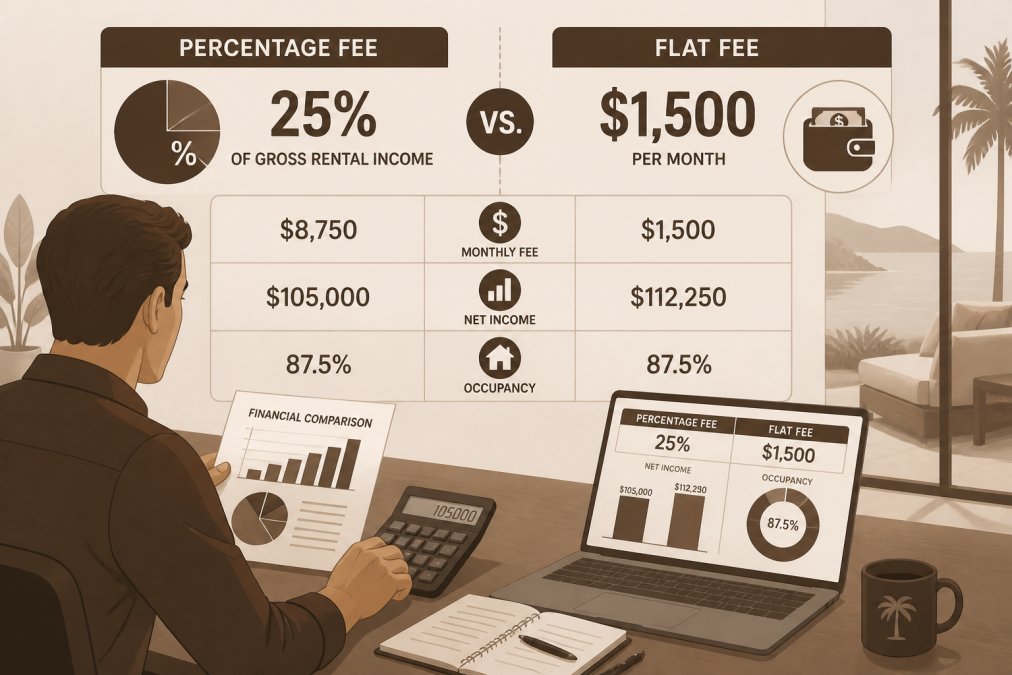
The management fee structure you choose fundamentally shapes your financial model. Most professional property managers operate on one of two models: a percentage of monthly rent collected, or a flat monthly fee regardless of occupancy.
Percentage-based pricing typically ranges from 8-15% of gross rent for residential properties, though luxury vacation rentals often command higher percentages due to hospitality management complexity. The advantage is alignment, your manager earns more when your property generates more revenue. The disadvantage is unpredictability; a 40% occupancy month costs dramatically less than a 90% occupancy month.
Flat-fee models charge a fixed monthly amount regardless of occupancy. This provides budget certainty and protects you during slow seasons, but your manager's incentive to maximize occupancy diminishes. Many flat-fee managers add performance bonuses to address this misalignment.
High-occupancy properties benefit from percentage-based fees because the alignment drives optimization. Seasonal properties may favor flat fees to protect against unpredictable months. When evaluating property management costs, request a complete breakdown showing how fees apply across different occupancy scenarios.
Hidden Property Management Fees You Need to Know
The advertised management fee represents only a portion of what you'll actually pay. Professional property management involves numerous ancillary costs that accumulate quickly.
Tenant placement fees are among the largest hidden costs. When a unit turns over, managers typically charge a fee to advertise the vacancy, screen applicants, conduct background checks, and execute the lease. These fees often range from half a month's rent to a full month's rent and apply every time a tenant transitions.
Maintenance and repair markups are standard across the industry. Property managers typically add 10-20% markup to contractor invoices to cover administrative overhead in vetting vendors, scheduling work, and ensuring quality.
Eviction coordination and legal fees apply when tenant disputes arise and can exceed several thousand dollars depending on jurisdiction and complexity.
Lease renewal fees charge owners when existing leases renew, typically 25-50% of the placement fee, creating recurring annual costs for long-term rentals.
Vacancy fees and marketing costs vary widely. Some managers charge owners for vacancy-related marketing or professional photography; others absorb these costs into their management fee.
Setup and onboarding costs apply when transitioning a property to new management, typically ranging from a flat amount to a percentage of first month's rent.
The cumulative impact of these hidden fees often exceeds the advertised management fee percentage. A manager charging 10% of gross rent might add another 3-5% in combined ancillary fees. Request a detailed fee schedule showing every possible charge; transparent managers itemize each fee type with clear triggers.
Tenant Placement Fees and Leasing Costs
Tenant placement represents a critical juncture where property management costs spike. Every lease transition triggers placement fees that fundamentally affect your property's profitability.
Placement fees typically charge owners for marketing the vacancy, collecting and reviewing applications, conducting background and credit checks, coordinating viewings, and executing the lease agreement. The fee structure varies: some managers charge a flat amount per placement, others charge a percentage of annual rent or first month's rent.
For vacation rental properties, the placement model differs from traditional residential management. Guest acquisition involves continuous marketing and revenue management rather than discrete placement events. However, managers still charge for lease execution when longer-term rentals are involved.
The financial impact depends on your turnover rate. Properties with 50%+ annual turnover, common for vacation rentals, incur substantial cumulative placement costs. A property with two tenant turnovers per year at 50% of first month's rent effectively adds 1% to annual management costs beyond the advertised fee percentage.
Negotiating placement fees often reveals flexibility. Some managers reduce fees for longer-term leases because they reduce turnover, or bundle placement fees into their base management percentage for multi-year commitments.
Property Management Contract Negotiation: What to Watch For
The management agreement you sign determines not only your fees but also your rights, responsibilities, and exit options.
Contract length and termination clauses deserve careful attention. Month-to-month agreements provide flexibility but may result in higher fees. Multi-year contracts lock in fees but limit your ability to switch providers. Understand the termination notice period required and whether early termination carries penalties.
Performance guarantees and remedies are often absent from management contracts. Ask explicitly what happens if your property underperforms occupancy targets or what recourse you have if maintenance quality declines.
Fee escalation clauses determine how your costs increase over time. Some contracts lock fees for the contract term; others include automatic annual increases tied to inflation or manager discretion.
Maintenance and repair approval thresholds define when managers can authorize work without your approval. Higher thresholds provide convenience but reduce your oversight.
Accounting and financial reporting standards should specify monthly reporting with itemized expenses. Demand that maintenance markups and ancillary fees appear as separate line items.
Exclusive vs. non-exclusive representation affects your ability to market your property independently. Some contracts require exclusive management; non-exclusive arrangements let you supplement the manager's marketing with your own efforts.
Review the management agreement with legal counsel familiar with property management law in your jurisdiction. The $500-1,000 legal fee for contract review often prevents far larger financial losses from unfavorable terms.
ROI Analysis: Self-Management vs. Professional Property Management
The decision between self-managing and hiring professional management ultimately comes down to financial returns.
Self-management eliminates management fees but introduces hidden costs. Remote owners managing properties across time zones spend 10-20 hours monthly on guest communication, maintenance coordination, booking management, and financial tracking. If you value your time at $50-100 per hour, this unpaid labor cost exceeds 10% of monthly rent for many properties.
Professional management converts this time cost into a financial fee while adding operational advantages. Professional managers operate systems optimized for revenue maximization: dynamic pricing models, occupancy forecasting, guest experience optimization, and direct-booking acquisition strategies. These capabilities generate measurable revenue improvements that self-managed properties typically cannot match.
If your self-managed property generates 50% occupancy at $150 per night, professional management might improve this to 65% occupancy at $170 per night through pricing optimization and marketing. The revenue increase, roughly 55% higher monthly income, often justifies professional management fees that consume 10-15% of gross rent.
Calculate your true self-management cost by accounting for your time, maintenance coordination overhead, and missed revenue optimization. Compare this total cost against professional management fees plus any performance improvements you'd expect. Properties in competitive markets with optimization potential almost always show positive ROI for professional management.
Tax Deductibility and Financial Planning
Property management fees represent a legitimate business expense that reduces your taxable rental income.
Management fees paid to professional property managers are fully deductible as ordinary and necessary business expenses. This applies to percentage-based fees, flat monthly fees, and performance bonuses. The deduction reduces your taxable income dollar-for-dollar, effectively lowering your tax liability by your marginal tax rate.
Ancillary fees associated with management, tenant placement, lease renewal fees, and maintenance coordination are also deductible. Maintenance markups on contractor invoices are deductible as maintenance expenses.
Setup and onboarding fees paid when transitioning to new management are typically deductible in the year incurred. Consult your tax advisor on timing.
The tax deductibility of management fees makes the effective cost lower than the nominal percentage. A 10% management fee is effectively 7-8% after accounting for tax savings at a 25-35% marginal rate. This calculation should factor into your ROI analysis when comparing self-management to professional management costs.
The true cost of full service property management extends far beyond the advertised percentage or monthly fee. Transparent fee structures reveal the complete financial picture: tenant placement costs, maintenance markups, lease renewal fees, and vacancy management all accumulate to create your actual cost of professional management.
For remote owners of luxury properties in Costa Rica, professional management delivers value that justifies these costs through revenue optimization, guest experience excellence, and operational reliability. Marquis Stays Property Management combines comprehensive management services with data-driven revenue strategies specifically designed for high-end coastal properties. Our approach focuses on maximizing direct-booking revenue while handling every operational detail, from guest communication to maintenance coordination, so you maintain clear visibility and control from anywhere in the world. List My Property with Marquis Stays and discover how professional management transforms your property into a consistently profitable asset.
Frequently Asked Questions
What percentage do most property management companies charge?
Industry-standard property management costs typically range from 8-12% of monthly rental income for full service management. However, the actual cost depends on your property type, location, and the specific services included. Luxury vacation rentals often command different fee structures than residential rentals. Always request a detailed breakdown of what services are covered at each fee tier to understand the true value proposition.
What hidden costs should I look for in a property management contract?
Beyond the base management fee, watch for maintenance reserve markups (often 15-30% above vendor costs), tenant placement and leasing fees (typically $300-600 per placement), vacancy fees, lease renewal charges, and eviction coordination costs. Some contracts include setup or onboarding fees. Request a complete fee schedule before signing, and ask specifically about any charges that apply when the property sits vacant or when tenants turn over.
Are property management fees tax deductible?
Yes, property management fees are generally tax deductible as a business expense if the property is rented out for profit. This includes the base management fee, tenant placement costs, and lease renewal fees. However, capital expenditures and certain maintenance reserves may not be fully deductible in the year incurred. Consult your accountant or tax professional to understand how your specific fee structure affects your tax situation, as deductibility depends on your property type and business structure.
Is full service property management worth the cost for a single rental unit?
For a single unit, the decision hinges on your occupancy rate, location, and time availability. If your property maintains 80%+ occupancy and generates sufficient rental income, professional management can increase revenue through better marketing, optimized pricing, and reduced vacancy periods. The cost-benefit improves significantly if you live remotely or lack time for guest communication, maintenance coordination, and tenant screening. Calculate your current vacancy losses and management time value to determine the true ROI.
This article was written using GrandRanker