Last Updated: November 10, 2026
Quick Summary
The best coastal hiking trails for families in Costa Rica are short, shaded routes under 3 km round trip that end at a beach or viewpoint. Manuel Antonio's coastal loop and Tamarindo's beach access paths are good choices, and families should plan around the youngest child's pace and the heat.
- Choose trails under 3 km round trip for children under ten.
- Look for shade, flat or gently sloping terrain, and a beach at the end.
- Manuel Antonio's coastal loop takes about 1.5 to 2.5 hours with kids.
- Plan the hike around the youngest person in the group, not the strongest.
- Start early, since midday heat in the coastal lowlands can be intense.
Table of Contents
- Which Coastal Hiking Trails Work Best for Families
- Kid-Friendly Hiking Trails in Costa Rica: Quick Comparison
- Easy Hikes Near Beaches in Costa Rica by Age and Ability
- How Long Should a Family Coastal Hike Be
- What to Pack for a Family Hike in Costa Rica
- Seasonal Conditions and Safety on Coastal Trails
- Planning Your Family's First Coastal Hike Day
- Frequently Asked Questions
Costa Rica's coastline offers some of the most rewarding hiking in Central America, but choosing the right coastal hiking trails for families takes planning. Families often ask which trails are short enough for young children, which have safe swimming nearby, and which are realistic for a full day with snacks and tired legs. This guide answers those questions with practical, family-focused advice.
Which Coastal Hiking Trails Work Best for Families
The best coastal hiking trails for families share three traits: a short distance, shade for much of the route, and a beach at the end. Trails under three kilometers round trip suit most children under ten. Trails with gentle, well-maintained paths are safer than rocky scrambles.
Look for these features when you choose:
- Distance under 3 km round trip
- Mostly flat or gently sloping terrain
- Shade from trees along the route
- A beach, cove, or viewpoint as the reward
- Restrooms or water access nearby
Coastal trails in national parks often meet these criteria better than trails in the hills. Confirm current access rules and visitor limits with the park before you go, since they can change.
Kid-Friendly Hiking Trails in Costa Rica: Quick Comparison
Most family coastal hikes fall into a small set of routes, and the differences that matter to parents are rarely the ones listed on general travel sites. The table below compares the criteria families usually check first: approximate distance, time needed, terrain, beach access, facilities, and the youngest age that tends to cope well. Figures are planning estimates rather than guarantees, and entrance fees and opening hours change, so confirm them with the park before you travel.
| Trail Area | Approx. Length | Typical Duration (with kids) | Terrain | Beach Access | Facilities | Suggested Minimum Age |
|---|---|---|---|---|---|---|
| Manuel Antonio coastal loop | Under 3 km | 1.5 to 2.5 hours | Packed dirt, some roots and steps | Yes, at the end of the loop | Restrooms and water near the entrance | Around 5 and up, with carrier for younger children |
| Tamarindo beach access paths | Short, mostly flat | 30 to 60 minutes | Sand and packed trail | Direct | Limited; use beachfront businesses | Most ages |
| Guanacaste dry forest paths | Varies by park | 1 to 2 hours | Mostly flat, very little shade | Often indirect | Check at park office | Around 6 and up, because of heat exposure |
| La Fortuna waterfall walks | Short, with some steps | 1 to 2 hours | Stairs and uneven stone | Not applicable | Entrance facilities and water | Around 6 and up for safe footing |
Entrance rules, parking availability, and whether stroller or carrier use is permitted can change, so check each park's current policy before your visit.
Easy Hikes Near Beaches in Costa Rica by Age and Ability
Age changes what counts as an easy hike. Toddlers need a carrier or stroller-friendly path. Children aged six to ten can usually manage a short loop with breaks. Teens can handle longer, more uneven routes.
- Under 5: Short boardwalks and paved paths only
- Ages 6-10: Loops under 3 km with a beach stop
- Ages 11-15: Trails up to 5 km with some uneven ground
- Adults with mobility limits: Choose flat, shaded paths with rest benches
Plan the hike around the youngest person in the group, not the strongest.
How Long Should a Family Coastal Hike Be
For most families, a coastal hike should last 60 to 90 minutes each way, including stops. This leaves time for swimming, snacks, and wildlife viewing. Many families find that a two-hour outing with one beach break works better than a full-day trek.
Start early, since midday heat in the coastal lowlands can be intense and wildlife is often more active in the morning. Build in extra time for bathroom breaks and photos, since children move slowly on trails.
What to Pack for a Family Hike in Costa Rica
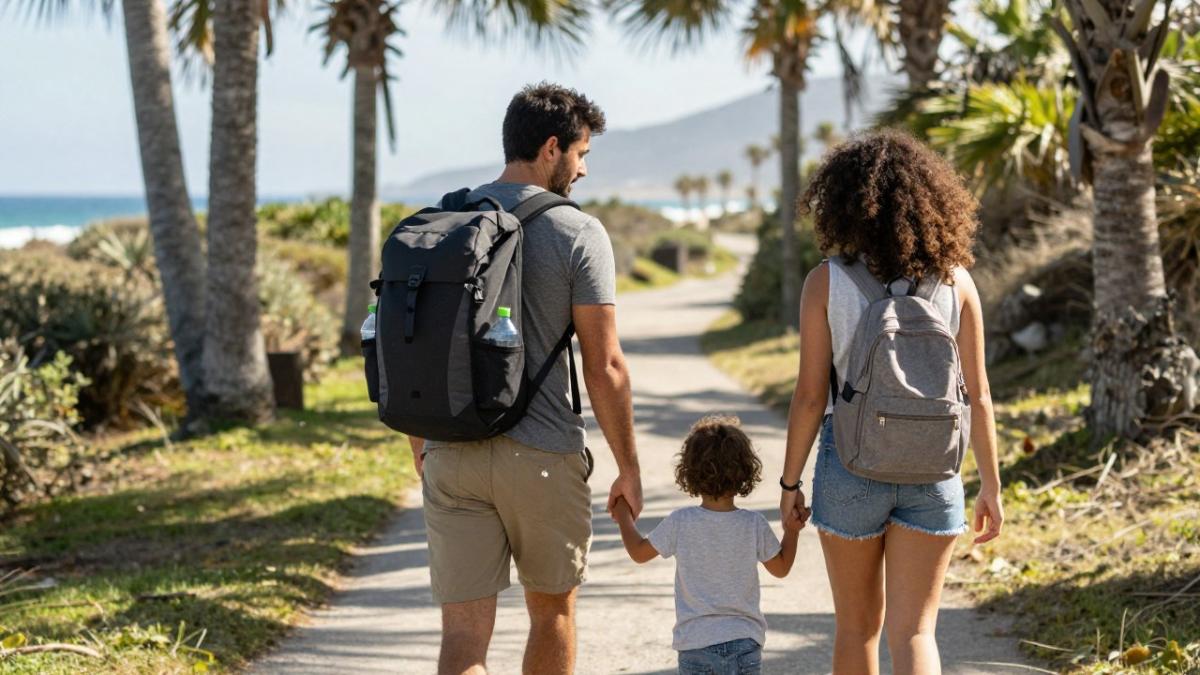
Pack light but pack smart. Bring enough water for everyone, plus a spare bottle. Coastal humidity makes dehydration happen faster than most visitors expect.
- Water: at least 1 liter per person per hour of walking
- Reef-safe sunscreen and a hat for each child
- Insect repellent suited for tropical areas
- Light rain jacket, since afternoon showers are common
- Sturdy closed shoes with grip, plus sandals for the beach
- Small first-aid kit with blister care and antihistamines
- Snacks that don't melt, such as nuts and fruit
- Dry bag for phones and wallets near water
Leave bulky items at your accommodation. Carrying gear is the most common reason young children get tired early.
Seasonal Conditions and Safety on Coastal Trails
Coastal hiking in Costa Rica carries hazards that inland trails do not, and most of them depend on the time of year and the tide. Families who plan around these factors tend to have shorter, calmer outings.
The dry season, roughly December through April, brings the most reliable weather and the easiest footing, but it also means the hottest midday temperatures on exposed coastal sections. The green season, from roughly May through November, keeps trails cooler and more lush, while bringing afternoon downpours that can turn clay paths slick and raise river levels at small crossings. Rain-related changes are most noticeable in the late afternoon, so planning the return walk before midday reduces the risk.
Tides change the walk itself. Several beach-access routes pass sections of sand that are passable at low tide but cover or narrow sharply at high tide. Checking the tide table before departure lets you choose a window when the full route is open, and turning back early is a sensible choice when waves reach the vegetation line.
River crossings appear on some access routes, particularly near river mouths. Water levels rise quickly after rain, even when the sky over the trail looks clear. Families with young children should skip any crossing that is above ankle depth, that moves quickly, or that a local guide has advised against.
Surf and currents are the most serious safety factor. Many Pacific beaches have strong rip currents, and lifeguard coverage is not universal. Swim only where lifeguards are present or where local staff confirm conditions are safe, and keep children in water no deeper than their waist unless an adult is holding them.
Wildlife also shifts with the seasons. Nesting sea turtles use some beaches during specific months, and staying well back from marked nesting areas protects both the animals and your family from disturbance or fines. Monkeys and coatis are most active in the morning, and keeping food sealed and away from wildlife avoids conflicts.
Slippery roots and wet rock near coastal streams are a common hazard, so use closed shoes with grip even on short walks.
A simple routine helps: check the tide table and the day's weather forecast, pick the morning window, carry a charged phone and a written copy of the park's emergency contact, and agree on a turnaround time before you set out.
Planning Your Family's First Coastal Hike Day
Start with one trail, not three. Pick a short route near your accommodation, check the park's opening hours, and plan a simple schedule: arrive early, walk to the beach, swim, and return before the afternoon heat peaks.
If you own a property in one of these areas and want help planning family guest experiences, Marquis Stays Property Management can share local insight on trails and family-friendly activities that suit your guests. You can explore family-friendly beach destinations in Costa Rica or read about quieter Costa Rica regions for a restful family base to plan your next trip.
Frequently Asked Questions
What are the best coastal hiking trails for families in Costa Rica?
The most family-suitable coastal hikes are short, shaded and end at a beach or swimming spot. Look for trails of roughly one to two kilometres, flat or gently sloping terrain and a clear trailhead with parking. Choose trails near established national parks, where paths are maintained and rangers or signage are available. Check current trail conditions and opening hours before you go, since access rules and closures change, and treat any trail length or duration in this guide as an estimate to confirm locally.
Are coastal hiking trails suitable for strollers?
Most coastal trails in Costa Rica are not stroller-friendly. Paths often feature roots, loose sand, rocks, steps and uneven ground, which make pushing difficult. A soft-carrier or lightweight hiking carrier works far better for toddlers. If you do bring a stroller, limit yourself to the flattest sections near the trailhead and expect to carry it over sand or rough patches.
How long should a family coastal hike be?
For children under about six, aim for an out-and-back distance that a child can walk comfortably with breaks, usually well under two kilometres in total. Older children with hiking experience can manage longer routes. Plan extra time for stops at beaches, wildlife viewing and swimming, and always allow enough daylight to return before dark, since coastal trails can become hard to follow at dusk.
What should families pack for a coastal hike?
Bring more water than you think you need, reef-safe sunscreen, insect repellent, a hat, a light rain layer, snacks, a basic first-aid kit and a change of dry clothes for the drive back. Pack sandals or water shoes for beach crossings and closed-toe shoes with grip for the trail itself. Carry a dry bag for phones and cameras, and a small towel for swimming stops.